Developmental Delays & Neurodivergence
They're Not Avoiding Eye Contact to Be Difficult. They're Trying to Survive the Visual Overload.
If your child has autism, ADHD, sensory processing disorder, or developmental delays, vision problems might be making everything harder. Discover how specialized vision care can help them feel less overwhelmed, more focused, and more connected to the world around them.
The Hidden Vision Connection Parents Miss
You’ve Been Told “It’s Just Part of Their Condition.” But What If It’s Not?
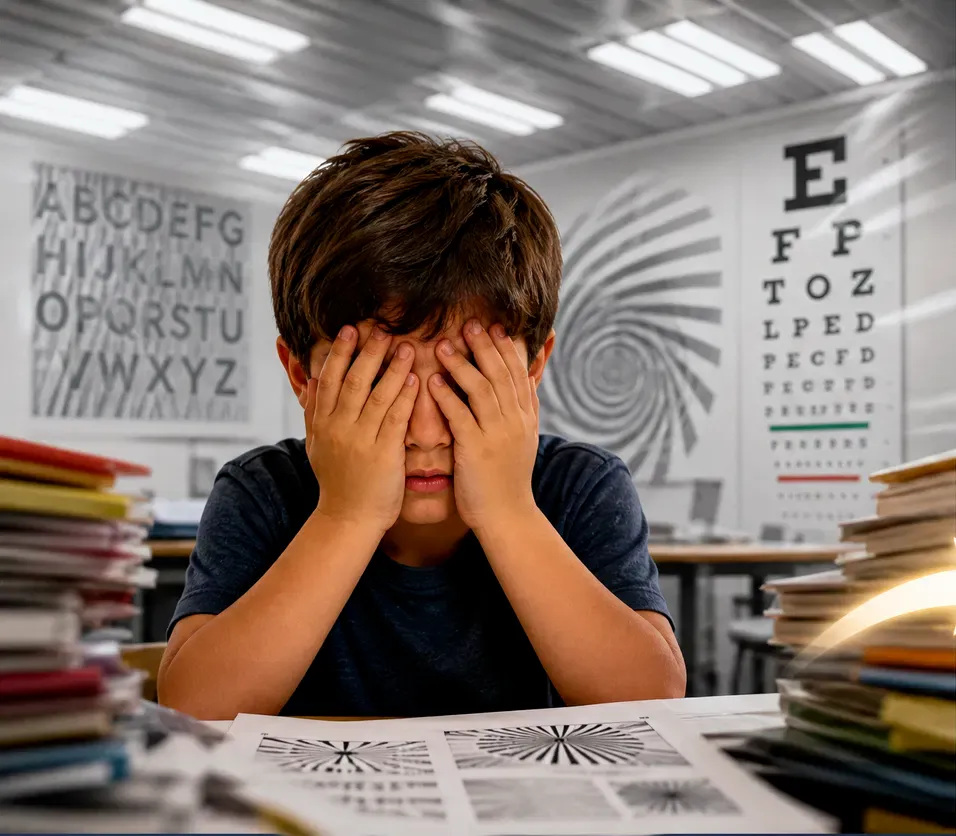
You see it every day. Your child avoids eye contact. They stare at spinning objects or lights. They struggle with coordination, bump into things, or seem clumsy. They have meltdowns in bright or busy environments. They can’t focus on tasks that require visual attention.
You’ve been told this is “just part of autism” or “typical ADHD behavior” or “sensory processing issues.” And while those diagnoses are real and valid, here’s what most parents don’t know:
Many of the behaviors attributed to autism, ADHD, and sensory processing disorder are actually caused—or made significantly worse—by untreated vision problems.
Here's the Science:
According to the College of Optometrists in Vision Development (COVD), the signs of vision problems can be masked by the behaviors that autistic individuals use to cope with the sensory overload of the world around them.[1]
Behaviors attributable to both autism and vision problems:
- Lack of eye contact
- Staring at spinning objects or light
- Fleeting peripheral glances
- Side viewing
- Difficulty attending visually
All About Vision reports that autistic individuals often go without routine eye exams, even though they face a higher chance of certain eye conditions. [2] Some find it hard to explain changes in their eyesight. Others might show signs through behavior, such as squinting, avoiding bright lights, or resisting eye contact.
These signs can be misunderstood if vision isn’t considered part of the issue.
The ADHD Misdiagnosis Problem:
Here’s something that might shock you:
Children with vision problems are 200% more likely to be diagnosed with ADHD. [3]
According to COVD, “Undetected and untreated vision problems can elicit some of the very same signs and symptoms that are commonly attributed to ADHD. Due to these similarities, some children with vision problems are mislabeled as having ADHD.” [4]
Children with convergence insufficiency (a common vision problem) are three times more likely to be diagnosed with ADHD than children without the disorder. [5]
The Question You Need to Ask:
What if your child’s struggles aren’t just behavioral—what if their visual system is working overtime just to make sense of the world, leaving them exhausted, overwhelmed, and unable to focus?
Why Vision Problems Are So Common in Neurodivergent Children
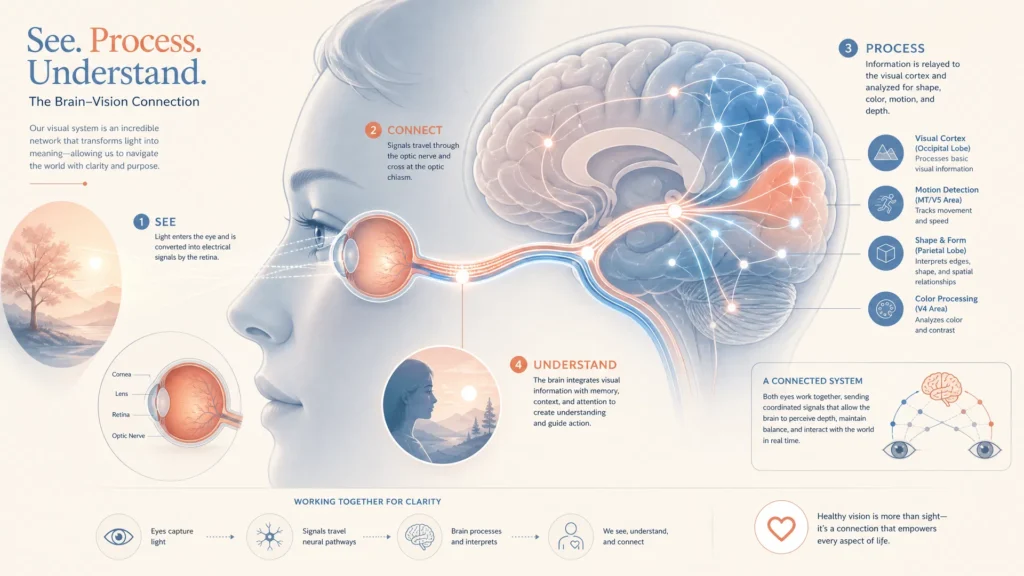
The Brain-Vision Connection
Vision is not just about seeing clearly—it’s about how the brain processes, interprets, and responds to visual information. For children with autism, ADHD, sensory processing disorder, or developmental delays, the visual system often doesn’t develop typically.
Autism & Vision
Many autistic people are “visually defensive.” They avoid contact with specific visual input and might have hypersensitive vision. They have difficulty with visually holding still and frequently rely on constant scanning of visual information in an attempt to gain meaning.[6]
ADHD & Vision
Convergence insufficiency (CI) is a common binocular vision disorder. CI is often associated with symptoms that look exactly like ADHD: eyestrain, headaches, blurred vision, difficulty concentrating, sleepiness, and loss of comprehension after short periods of reading.[8]
Sensory Processing Disorder & Vision
Vision is the dominant sense for most children, accounting for 80% of all sensory input to the brain. When the visual system is not functioning properly, it can trigger or exacerbate sensory processing difficulties.[10]
Does This Sound Like Your Child?
Common Signs That Vision Problems Are Making Everything Harder
♦ Visual Behaviors
- Avoids eye contact or finds it uncomfortable
- Stares at spinning objects, fans, or lights
- Uses peripheral (side) vision instead of looking directly at objects
- Covers or closes one eye when reading or doing close work
- Tilts or turns head to use one eye only
- Squints or avoids bright lights
♦ Coordination & Motor Skills
- Appears clumsy or bumps into things frequently
- Has poor depth perception (misjudges distances)
- Struggles with fine motor tasks (writing, buttoning, tying shoes)
- Has difficulty catching or throwing a ball
- Poor balance or coordination
♦ Focus & Attention
- Can't sustain attention on visual tasks
- Easily distracted by visual stimuli
- Difficulty shifting focus from one object to another
- Seems to 'zone out' during visual activities
- Fidgets or moves constantly to stay engaged
♦ Reading & Learning
- Avoids books or visual learning activities
- Loses place while reading
- Skips lines or rereads the same line
- Poor reading comprehension despite intelligence
- Complains of words moving or blurring
♦ Sensory & Emotional
- Meltdowns in visually busy environments (stores, crowds)
- Overwhelmed by fluorescent lights or patterns
- Anxiety in new or visually complex spaces
- Difficulty with transitions or changes in environment
If you checked 3 or more of these, vision problems may be contributing to your child’s struggles.
How We Help: A Neuro-Developmental Approach
We Don’t Just Treat Vision—We Support Your Child’s Whole Development
1. We Assess the Whole Visual System (Not Just 20/20 Vision)
A standard eye exam checks if your child can see letters on a chart. We assess 17+ visual skills that are critical for learning, coordination, and sensory regulation:
- Eye teaming (binocular vision)
- Eye focusing (accommodation)
- Peripheral awareness
- Visual attention
- Eye tracking (ocular motor skills)
- Visual processing
- Visual-motor integration
2. We Understand Neurodivergent Sensory Needs
We adapt our evaluation and treatment to your child’s unique sensory profile:
- Sensory-friendly exam rooms (adjustable lighting, quiet spaces)
- Flexible testing methods (no pressure for eye contact or verbal responses)
- Accommodations for movement, stimming, and sensory regulation
- Parent involvement and support throughout the process
3. We Treat the Root Cause—Not Just the Symptoms
Our treatment goals may include helping your child to:
- Organize visual space
- Gain peripheral stability
- Attend to and appreciate central vision
- Gain more efficient eye coordination
- Improve visual information processing
Achieving these goals can help your child feel less overwhelmed by visual stimuli and interact with the world more comfortably.
Your Child's Pathway to Feeling Less Overwhelmed
- 1
Comprehensive Neuro-Developmental Vision Evaluation
We assess all 17+ visual skills your child needs to feel comfortable, focused, and connected, including binocular vision, ocular motor skills, visual processing, and sensory-visual integration.
- 2
Personalized Neuro-Developmental Treatment Plan
Based on your child's unique visual and sensory profile, we create a customized plan that may include vision therapy, therapeutic lenses, sensory integration, and home activities.
- 3
Transform & Thrive
As your child's visual system becomes more efficient, you may notice improved eye contact, better focus, reduced sensory meltdowns, improved coordination, and greater confidence.
Real Stories from Parents Like You
“We Finally Understand Why Eye Contact Was So Hard”
“Our son was diagnosed with autism at age 3. We were told the lack of eye contact was ‘just part of autism.’ But after his vision evaluation at BVI, we learned he had severe binocular vision dysfunction—his eyes literally couldn’t work together. No wonder eye contact was so hard! After 6 months of vision therapy, he started making eye contact naturally. He’s more engaged, less overwhelmed, and so much happier. We wish we had known about this sooner.”
— Parent of 7-year-old with autism
“It Wasn’t ADHD—It Was Vision”
“My daughter was diagnosed with ADHD in 2nd grade. She couldn’t focus, couldn’t sit still, and avoided reading. We tried medication, but it didn’t help. Then we discovered she had convergence insufficiency—her eyes couldn’t work together for close work. After vision therapy at BVI, her ‘ADHD symptoms’ disappeared. She can focus, she loves reading now, and she’s thriving in school. Vision therapy changed our lives.”
— Parent of 9-year-old previously diagnosed with ADHD
“The Meltdowns Stopped”
“Our son with SPD had daily meltdowns in bright lights and busy places. We thought it was sensory overload—and it was, but it was visual sensory overload. BVI discovered he was ‘visually defensive’ and had tracking problems. With vision therapy and therapeutic lenses, the meltdowns decreased dramatically. He can go to the grocery store now without falling apart. It’s life-changing.”
— Parent of 6-year-old with sensory processing disorder
Why Families Choose Us
Specialized in Neurodivergent Children
We specialize in children with autism, ADHD, SPD, and developmental delays. We understand your child's unique needs.
Sensory-Friendly Environment
Our clinic is designed for sensory-sensitive children—adjustable lighting, quiet spaces, flexible scheduling, and no pressure for 'typical' behavior.
Neuro-Optometric Expertise
Our doctors are Fellows of the College of Optometrists in Vision Development (FCOVD) and members of the Neuro-Optometric Rehabilitation Association (NORA).
Whole-Child Approach
We don't just treat vision—we support your child's sensory, motor, cognitive, and emotional development.
Evidence-Based Treatment
Our therapies are backed by peer-reviewed research from COVD, NORA, the American Optometric Association, and leading neurodevelopmental experts.
Parent Partnership
You're part of the team. We educate, support, and empower you to help your child thrive.
Frequently Asked Questions
Your Questions, Answered
Will my child need to make eye contact during the exam?
No. We adapt our evaluation methods to your child’s comfort level. We never force eye contact or any behavior that causes distress. Our goal is to understand your child’s vision—not to change who they are.
My child is nonverbal. Can you still evaluate their vision?
Yes. COVD reports that “many COVD doctors are experienced in examining and treating autistic people as well as other developmentally delayed or non-verbal individuals.” [14] We use observation-based testing, specialized lenses, and functional assessments that don’t require verbal responses.
Will vision therapy cure my child's autism/ADHD/SPD?
How long does vision therapy take?
Every child is different. Typical programs range from 6-12 months, with weekly or bi-weekly sessions. Progress depends on the severity of the vision problem, your child’s age, and consistency with home activities.
Is vision therapy covered by insurance?
Some insurance plans cover vision therapy, especially when it’s medically necessary. We provide detailed documentation to help you maximize your benefits. We also offer flexible payment plans.
What if my child can't tolerate the therapy activities?
We design therapy activities around your child’s interests, sensory needs, and developmental level. If something isn’t working, we adapt. Our goal is progress, not perfection.
Can vision therapy help with meltdowns and sensory overload?
Yes. When the visual system is functioning more efficiently, the brain has more capacity to regulate other sensory input. Many parents report significant reductions in sensory meltdowns after vision therapy.
My child already wears glasses. Isn't that enough?
Regular glasses correct for distance vision (20/20 on a chart). They don’t address eye teaming, tracking, focusing flexibility, visual processing, or sensory-visual integration—the skills that are often impaired in neurodivergent children.
References
-
- College of Optometrists in Vision Development. (n.d.). Autism & Vision. Retrieved from https://www.covd.org/page/autism
- All About Vision. (2025). Eye health and behaviors associated with autism. Retrieved from https://www.allaboutvision.com/conditions/related/autism-and-vision/
- Optometrists Network. (n.d.). How are ADHD and vision problems related? Top 6 Q&As. Retrieved from https://www.optometrists.org/vision-therapy/vision-therapy-for-adhd/how-are-adhd-and-vision-problems-related-top-6-qas/
- College of Optometrists in Vision Development. (n.d.). ADHD & Vision. Retrieved from https://www.covd.org/page/adhd
- Granet, D. B., et al. (2005). The relationship between convergence insufficiency and ADHD. Children’s Eye Center, University of San Diego. Retrieved from http://www.ncbi.nlm.nih.gov/pubmed?cmd=Retrieve&list_uids=16361187&dopt=AbstractPlus
- College of Optometrists in Vision Development. (n.d.). Autism & Vision. Retrieved from https://www.covd.org/page/autism
- Neuro-Optometric Rehabilitation Association. (n.d.). Conditions treated by neuro-optometric rehabilitation. Retrieved from https://noravisionrehab.org/patients-caregivers/conditions-treated-by-neuro-optometric-rehabilitation
- Brain Vision Institute. (n.d.). Sensory processing disorders. Retrieved from https://www.brain-vision.org/who-we-can-help/sensory-processing-disorders/
- College of Optometrists in Vision Development. (n.d.). Autism & Vision. Retrieved from https://www.covd.org/page/autism
- Neuro-Optometric Rehabilitation Association. (n.d.). Conditions treated by neuro-optometric rehabilitation. Retrieved from https://noravisionrehab.org/patients-caregivers/conditions-treated-by-neuro-optometric-rehabilitation
- College of Optometrists in Vision Development. (n.d.). Autism & Vision. Retrieved from https://www.covd.org/page/autism
Don't Wait and See. Take the First Step Today.
Your Child Doesn’t Have to Feel So Overwhelmed
Imagine your child:
- Feeling more comfortable in their own body
- Engaging with activities they used to avoid
- Making connections (visual and social) more easily
- Experiencing fewer meltdowns and less frustration
- Thriving in ways you didn’t think were possible
This is what’s possible when vision is no longer a barrier.