

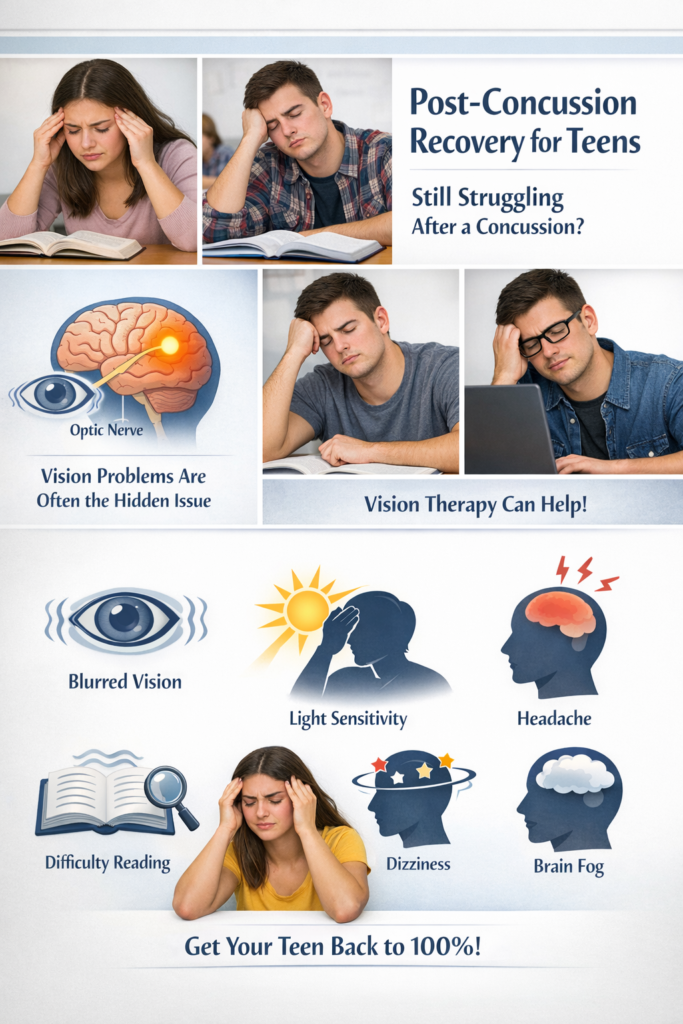
Post-Concussion Recovery for Teens
Your Teen Was Cleared After Their Concussion.
So Why Are They Still Not Themselves?
They were told to rest in a dark room for a few days, and their coach said they were fine to play. But weeks or even months later, your teen is still struggling with headaches, brain fog, and difficulty in school. Up to 90% of concussion patients experience vision problems, which are often the hidden cause of lingering symptoms. The good news? These vision problems are treatable, and a targeted vision therapy program can be the key to getting your teen back to 100%.
vision
problems
When Rest Isn't Enough: Understanding Post-Trauma Vision Syndrome
You followed the doctor’s orders. You kept your teen home from school. You limited screen time. But the headaches persist. They have trouble concentrating on homework. They feel dizzy or off-balance. What you’re seeing are the classic signs of Post-Trauma Vision Syndrome (PTVS).
A concussion doesn’t just shake the brain; it disrupts the communication between the brain and the eyes. The visual system, which involves more than 50% of the brain’s pathways, is incredibly vulnerable to injury. When this system is compromised, it can lead to a host of debilitating symptoms that don’t go away with rest alone.
Common Symptoms of Post-Trauma Vision Syndrome:
- Headaches and eye strain, especially with reading or screen time
- Dizziness, nausea, or motion sickness
- Sensitivity to light and busy environments (like crowded hallways or stores)
- Blurred or double vision
- Difficulty tracking moving objects or words on a page
- Poor depth perception, leading to clumsiness
- Brain fog and difficulty concentrating
"The eyes are literally an extension of the brain. When you have a brain injury, you will almost certainly have a vision problem. The problem is, most people, including many doctors, don't know to look for it."
-- Daniel Amen, MD, Amen Clinics
Heal the Current Injury.
Prevent the Next One.
If your teen has had a concussion, you have two urgent concerns: helping them recover fully now, and protecting them from a second, potentially more devastating, injury in the future. Vision therapy is the only approach that addresses both.
A groundbreaking study from the University of Cincinnati on their NCAA Division I football team proved that vision training is a powerful tool for concussion prevention.[1] The study found that after implementing a comprehensive vision training program, the team experienced an 85% reduction in concussions. Players with trained visual systems were better able to anticipate and avoid dangerous collisions.
This is critical for your teen. The same vision therapy that rehabilitates their brain-eye connection after an injury also builds the visual skills that act as a shield against future impacts. By improving their peripheral awareness and reaction time, you are not just healing them—you are inoculating them against future injury.
How a Hidden Vision Problem Derails a Teen's Academics, Sports, and Social Life
The Struggling Student
The Problem:
Your teen tries to read a textbook, but the words seem to swim on the page. The bright classroom lights feel overwhelming. Shifting focus from the board to their notes triggers a headache.
The Result:
Plummeting grades, incomplete homework, and the frustration of being told they’re “not trying hard enough” when in reality, their brain is working overtime just to see clearly.
The Benched Athlete
The Problem:
Your teen is cleared to play, but they don’t feel right. They’re a step slower, their timing is off, and they feel hesitant on the field. They’ve lost their competitive edge and their confidence.
The Result:
Reduced playing time, frustration, and an increased risk of a second, more severe concussion because their ability to react to their environment is compromised.
The Socially Withdrawn Teen
The Problem:
The noise and motion of a crowded cafeteria or a party feel overwhelming and trigger dizziness. Scrolling on their phone to text friends causes eye strain and headaches.
The Result:
They start to withdraw, avoiding social situations they used to enjoy. They feel isolated and misunderstood, which can lead to anxiety and depression.
Re-wiring the Brain-Eye Connection: Our 3-Step Post-Concussion Protocol
We don’t believe in a “wait and see” approach. We use an active, evidence-based protocol to help your teen’s brain heal.
The Post-Concussion Neuro-Visual Evaluation
1
This is the critical first step. We go far beyond a standard eye exam to assess the specific visual skills disrupted by a concussion. We use advanced technology and clinical testing to measure eye tracking, focusing, teaming, depth perception, visual processing speed, and light sensitivity.
A Data-Driven Diagnosis & Recovery Plan
2
Based on the evaluation, we identify the exact nature of your teen’s Post-Trauma Vision Syndrome. We then create a personalized recovery plan that may include:
- Specialized Therapeutic Lenses: Glasses with specific tints or prisms to reduce light sensitivity, eliminate double vision, and help the eyes work together more efficiently.
- A Customized Vision Therapy Program: A one-on-one program of in-office and at-home exercises designed to rebuild and strengthen the neural connections between the eyes and the brain.
Active Rehabilitation & Return to Life
3
This is where your teen actively retrains their brain. Through a guided program of vision therapy, they will:
- Improve visual skills: Regain the ability to track, focus, and team their eyes effortlessly.
- Reduce symptoms: See a significant decrease in headaches, dizziness, and light sensitivity.
- Rebuild confidence: Feel ready and able to return to the classroom and their sport safely.
We work closely with your teen’s entire medical team—their primary care physician, neurologist, and physical therapist—to ensure a coordinated and successful recovery.
From the Sidelines to a Full Life:
Teen Concussion Recovery Stories
Frequently Asked Questions
Q1: The ER doctor said my teen's CT scan was normal. How can there still be a problem?
A1: A CT scan or MRI is designed to rule out a life-threatening brain bleed. It cannot detect the microscopic damage to the neural pathways that causes Post-Trauma Vision Syndrome. A functional vision evaluation is the only way to assess how the injury has affected the brain-eye communication.
Q2: How soon after a concussion should my teen have a vision evaluation?
A2: We recommend an evaluation within the first 1-4 weeks after the injury, especially if symptoms are not improving. Early intervention can lead to a faster and more complete recovery.
Q3: Is vision therapy just 'eye exercises'? Can't we just do them at home?
A3: Vision therapy is much more than simple exercises. It is a doctor-supervised program of neuro-rehabilitation. Each session builds on the last, using therapeutic lenses, prisms, and advanced technology to retrain the brain. It’s like physical therapy for the visual system and requires professional guidance.
Q4: Is the evaluation scary for my child?
A4: Not at all! We’ve designed our evaluation to be a positive and engaging experience. We use age-appropriate games, toys, and gentle techniques to assess your child’s vision. Our team is highly experienced in working with children, and our primary goal is to make them feel comfortable and safe.
Q5: My teen's concussion was over a year ago. Is it too late to get help?
A5: Absolutely not. The brain has an amazing ability to heal and create new pathways (neuroplasticity) at any age. We have successfully treated patients months or even years after their initial injury.
References
- Clark, J. F., et al. (2015). An exploratory study of the potential effects of vision training on concussion incidence in football. Optometry & Visual Performance.
- Amen Clinics. (n.d.). Concussions & Traumatic Brain Injury. amenclinics.com
- American Optometric Association. (n.d.). Traumatic Brain Injury. aoa.org
- College of Optometrists in Vision Development. (n.d.). Brain Injury & Vision. covd.org
Don't Wait for Symptoms to Disappear.
Give Your Teen the Tools to Heal.
Lingering concussion symptoms are a sign that the brain needs help to recover. A comprehensive post-concussion vision evaluation is the most important step toward identifying the root cause of your teen’s struggles and creating a roadmap for their full recovery.