
Posture & Balance Disorders
When You Feel Unsteady on Your Own Two Feet
You feel a subtle, persistent sense of being off-balance. Maybe you’re dizzy in crowded places, unsteady in the dark, or you’ve developed chronic neck and shoulder pain from unconsciously tilting your head to see clearly. This isn’t just a sign of getting older; it’s a sign that your brain’s balance system, which relies heavily on your vision, is in conflict. We can help you recalibrate your internal gyroscope and feel stable again.
Nearly
of balance depends on accurate visual input.
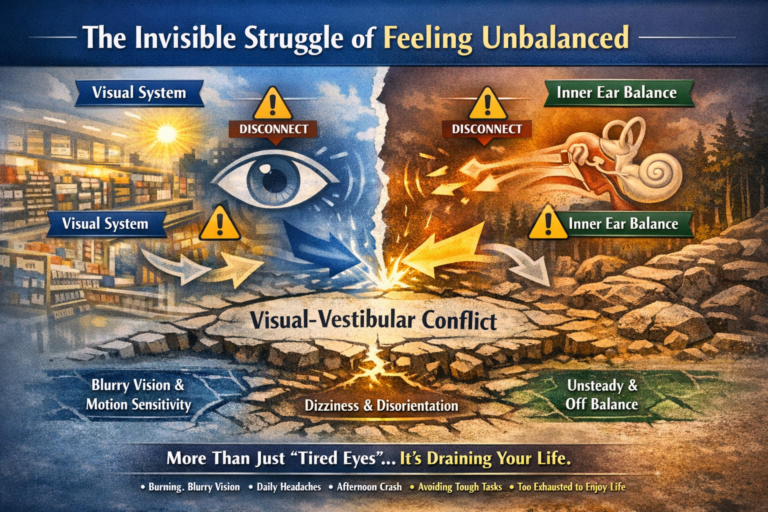
The Invisible Struggle of Feeling Unbalanced
Balance issues are often dismissed as clumsiness or anxiety, but they are frequently the result of a disconnect between your visual system and your vestibular (inner ear) system. When your brain receives conflicting information from these two systems, it creates a feeling of disorientation and instability.
Does this sound familiar?
- “I feel dizzy or overwhelmed in visually busy environments like grocery stores or malls.”
- “I have chronic neck, shoulder, or upper back pain that massages don’t fix.”
- “I feel unsteady or have a fear of falling, especially in low light or on uneven surfaces.”
- “I’ve been told I have a ‘head tilt,’ but I don’t realize I’m doing it.”
- “I experience mild but persistent nausea or motion sickness, even when I’m not moving.”
This is your body telling you that your brain is working too hard to maintain equilibrium. It’s a problem we can identify and treat.
Your Eyes Are the Captain of Your Balance System
Your brain maintains balance by integrating information from three sources: your vision, your vestibular system (inner ear), and your proprioceptive system (sense of body position). Vision is the most dominant of the three. If your visual information is flawed, the entire system can be thrown off.
How Vision Problems Disrupt Balance:
Vertical Heterophoria (Vertical Eye Misalignment):
This is a subtle condition where one eye is slightly higher than the other. To prevent double vision, your brain forces the eye muscles to work constantly to realign the images. This strain can cause headaches, dizziness, and a feeling of being off-balance. To compensate, many people unconsciously tilt their head, leading to chronic neck and shoulder pain [1].
Visual-Vestibular Mismatch:
After a concussion or with certain binocular vision disorders, the brain can have trouble integrating the information from the eyes and the inner ear. When you turn your head, your eyes are supposed to move in a coordinated way. If they don’t, your brain receives conflicting signals, resulting in dizziness, nausea, and disorientation.
Poor Spatial Awareness:
An inefficient visual system can lead to a poor sense of where you are in space, making you more likely to bump into things, misjudge distances, and feel generally clumsy or uncoordinated.
Recalibrating Your Brain’s GPS
Our approach is to use advanced diagnostic tools to pinpoint the source of the conflict between your visual and vestibular systems and then use targeted therapies to retrain them to work together in harmony.
The Neuro-Visual Balance Assessment
1
We perform a comprehensive evaluation that goes beyond a standard eye exam. We use specialized tests to measure for subtle vertical misalignments, assess how your eyes and inner ear are communicating, and evaluate your visual processing of motion and spatial information.
Your Personalized Stability Plan
2
Based on your assessment, we create a plan to restore your equilibrium. This may include:
- Contoured Prism Lenses: These are highly specialized lenses that correct for vertical heterophoria. By bending light to compensate for the eye misalignment, they allow the brain to relax, often providing immediate relief from dizziness, headaches, and neck pain.
- Neuro-Visual Therapy: We use a customized program of exercises to retrain the visual-vestibular connection, improving your brain’s ability to process motion and maintain balance in dynamic environments.
Re-Engaging with Your World Confidently
3
Our goal is to restore your sense of stability so you can move through your world with confidence. This means navigating a crowded store without feeling overwhelmed, walking in the dark without fear, and living without the chronic pain that comes from a tilted posture.
From Unsteady and Anxious to
Grounded and Confident
Frequently Asked Questions
Q1: How can my eyes cause neck pain?
A1: If you have a subtle vertical misalignment of your eyes, your brain will instinctively tilt your head to help align the images and prevent double vision. Holding this unnatural posture for years puts a tremendous strain on the muscles in your neck, shoulders, and upper back, leading to chronic pain.
Q2: I’ve seen an ENT and a neurologist, and they said everything is normal. How can you help?
A2: ENTs and neurologists are experts in the vestibular and central nervous systems, but they often do not have the specialized equipment to test for subtle visual misalignments or visual-vestibular integration problems. We work collaboratively with other specialists to find the missing piece of the puzzle, which is often visual.
Q3: Are prism lenses thick and heavy?
A3: Not anymore. Using modern digital lens manufacturing, we can create contoured prism lenses that are thin, light, and cosmetically appealing. Most people would not be able to tell they are any different from a standard pair of glasses.
Q4: Is this the same as vertigo?
A4: While the symptoms can be similar, vertigo is typically caused by a problem within the inner ear itself (like BPPV). Our specialty is in diagnosing and treating dizziness and imbalance that originates from a conflict between the visual system and the vestibular system.
References
-
Debby L. Feinberg, OD. (n.d.). What is Vertical Heterophoria?. NeuroVisual Medicine Institute. (Explains the link between vertical heterophoria and symptoms).
-
American Optometric Association. (n.d.). The Role of Vision in Balance and Dizziness. (Provides general information on the visual-vestibular connection).
-
College of Optometrists in Vision Development. (n.d.). Balance & Dizziness. (Explains the role of neuro-optometric rehabilitation).
-
National Institutes of Health. (n.d.). Balance Disorders. (Provides general information on balance disorders).
-
Centers for Disease Control and Prevention. (n.d.). Dizziness and Balance. (Provides general information on dizziness and balance).
-
Optometry & Vision Science. (Various articles on prism correction and visual-vestibular therapy).
-
Journal of the American Medical Association (JAMA). (Various articles on dizziness and balance disorders).
-
American Optometric Association (AOA) — Vision & Balance Integration Overview
Don’t Let Dizziness and Imbalance Limit Your Life.
Feeling stable and grounded is not a luxury; it’s essential for living a full and active life. If you are struggling with unexplained dizziness, balance issues, or chronic neck pain, a Neuro-Visual Balance Assessment may hold the answer you’ve been searching for.