

Light-Based Healing for Children
Healing with Light: How Photobiomodulation Is Transforming Vision, Learning & Brain Health in Children
So Why Hasn’t Anyone Mentioned Light Therapy?
Your child’s brain and eyes respond to light—not just for seeing, but for healing. Discover how cutting-edge light therapy is helping children with learning struggles, ADHD, autism, and vision problems thrive in ways you didn’t think were possible.
been used by
optometrists
Photobiomodulation: Recharging Your Child's Brain Cells with Light
Think of your child’s brain cells like rechargeable batteries. When they’re struggling with learning, attention, or behavior, it’s often because their “batteries” are running low—their brain cells don’t have enough energy to function properly.
Photobiomodulation (PBM) uses red and near-infrared light (about 600-1300 nm) applied to the head, eyes, or body to recharge those batteries at a cellular level. It’s been used safely and effectively for decades, and research shows it can help with:
- Autism spectrum disorder
- ADHD and focus problems
- Learning disabilities
- Myopia (nearsightedness) progression
- Concussion and brain injury recovery
- Inflammation and oxidative stress
- Gut-brain connection issues
In simple terms: PBM gives your child’s cells the energy they need to heal themselves.
"Photobiomodulation gives damaged cells the energy they need to repair themselves. It's one of the most promising, non-invasive tools we have for helping the brain heal after injury."
-- Brain Vision Institute
Syntonic Phototherapy: Healing Through the Eyes
Not all light-sensitive nerves in the eyes serve vision. Some connect the retina directly to non-visual brain centers such as the hypothalamus and pineal gland—centers that influence sleep, hormones, mood, stress response, and learning.
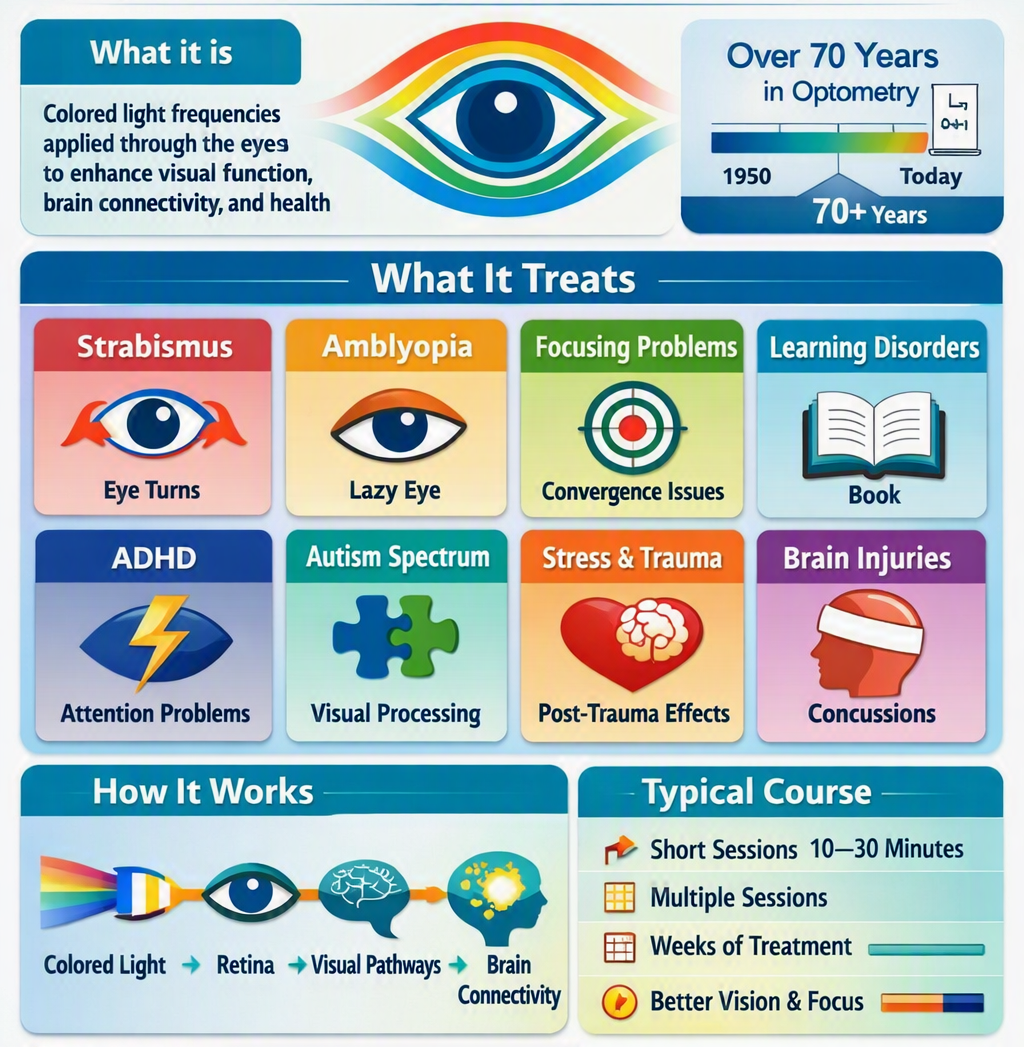
Syntonic Phototherapy uses specific, filtered colors of light, viewed through the eyes, to gently rebalance these brain centers and improve visual function. It has been used safely in optometry for over 70 years, with proven benefits for:
- Strabismus (eye turns) and amblyopia (lazy eye)
- Focusing and convergence problems
- Learning disorders, ADHD, and attention problems
- Autism spectrum (visual processing and sensory sensitivities)
- After-effects of stress, trauma, brain injury, and concussion
The result: improved visual skills, peripheral vision, memory, behavior, mood, and academic achievement.
Targeted, Drug-Free Solutions for Common Childhood Struggles
1. For Learning Disabilities:
How it Helps: Children with learning struggles often have reduced peripheral vision sensitivity and poor eye teaming, making it hard to take in a full page of text. Syntonic therapy has been shown to improve peripheral vision, memory, behavior, and academic achievement.
2. For Autism Spectrum:
How it Helps: Photobiomodulation improves brain connectivity, calms chronic inflammation, protects neurons, and supports the gut-brain connection—addressing the underlying visual overwhelm and sensory sensitivities, not just the behaviors.
3. For ADHD & Focus:
How it Helps: Many children diagnosed with ADHD actually have underlying visual processing problems. When visual function improves with light therapy, attention, short-term memory, and task completion often improve dramatically.
4. For Myopia Progression:
How it Helps: Red light photobiomodulation has been shown to slow axial length growth—the eye elongation that drives increasing nearsightedness—helping stabilize your child’s prescription.
Your Child's Pathway to Healing
We don’t believe in a one-size-fits-all approach. Every treatment plan is customized to your child’s unique needs, following a clear path from evaluation to lasting transformation.
Comprehensive Evaluation
1
We don’t just test if your child can see 20/20. We assess 17+ visual skills—including eye tracking, teaming, focusing, and peripheral vision sensitivity—along with brain-visual function and developmental history, to understand exactly why your child is struggling.
Personalized Light Therapy Plan
2
Based on your child’s specific needs, we create a customized plan that may include Syntonic Phototherapy (specific colored lights viewed for 20 minutes, 3-5 times per week) and/or Photobiomodulation (red and near-infrared light applied to the head, eyes, or body), often paired with vision therapy for faster, more lasting results.
Transform & Thrive
3
Many parents notice improvements in mood, sleep, and focus within the first 2-4 weeks. Full results—including measurable gains in visual skills, reading level, and behavior—typically develop over 8-12 weeks of treatment.
Real Stories of Light-Based Healing
Frequently Asked Questions
Is light therapy safe for children?
Yes. Both syntonic phototherapy and photobiomodulation have been used safely in children for decades.
Syntonic phototherapy has been used clinically for over 70 years in optometry with no known serious side effects, and research shows photobiomodulation is safe, non-pharmacological, and non-invasive, with only transient mild effects like temporary light sensitivity.
No drugs, no surgery, and no known long-term side effects.
How is this different from regular vision therapy?
Light therapy enhances and accelerates vision therapy results.
Vision therapy alone uses exercises to improve eye tracking, focusing, teaming, and visual processing—effective, but it can take 6-12 months.
Vision therapy + Light therapy improves cellular function, reduces inflammation, and enhances brain connectivity, making the brain more receptive to learning new visual skills. The result: faster progress, better outcomes, and more lasting results.
Will my child need to do this forever?
No. Light therapy is typically a short-term treatment lasting weeks to months, with long-lasting results—usually 4-12 weeks of active treatment (3-5 sessions per week), with occasional maintenance sessions as needed.
Once your child’s brain and visual system are functioning efficiently, the improvements last.
Think of it like physical therapy: intensive treatment for a period of time, then occasional tune-ups.
My child has autism. Will light therapy ‘cure’ it?
No treatment ‘cures’ autism, and that’s not our goal—we respect neurodiversity. Our goal is to address the underlying visual and neurological dysfunctions that make daily life harder, like overwhelming visual input, sensory sensitivities, gut-brain connection issues, and inflammation. Research shows photobiomodulation improves these underlying dysfunctions, which then improves quality of life: better sleep, less sensory overwhelm, and an easier time learning and engaging. We never force eye contact or any behavior that causes distress—our goal is to understand your child’s visual system, not to change who they are.
References
- College of Syntonic Optometry. (n.d.). What is Syntonics? Retrieved from csovision.org
- Hamilton, C., Liebert, A., Pang, V., Magistretti, P., & Mitrofanis, J. (2022). Lights on for Autism: Exploring Photobiomodulation as an Effective Therapeutic Option. Neurology International, 14(4), 884–893.
- Xceptional Learning. (2025). How Light Therapy is Being Used to Treat ADHD in Children. Retrieved from xceptionallearning.com
- Zhou, L., et al. (2023). Photobiomodulation therapy retarded axial length growth in children with myopia. Scientific Reports, 13, 7746.
Your Child Doesn't Have to Struggle Anymore.
You’ve tried tutoring, therapy, medication—and been told “it’s just ADHD” or “they’ll grow out of it.” But what if the answer has been there all along, in their visual system? The research is clear. The results are proven. The treatment is safe.