Primitive Reflex Assessment & Neurodegenerative Risk
Early Detection for Brain Health Protection
The re-emergence of primitive reflexes in older adults can be an early indicator of neurodegenerative disorders. These infant reflexes are normally held in check by the brain’s frontal lobes. When they begin to reappear, it can be a sign that those control systems are under strain. We provide comprehensive assessment and proactive intervention to support your long-term brain health.

More than
primitive reflex signs, with changes in memory or orientation, strongly suggest brain dysfunction worth investigating.
Small Changes You Can’t Quite Explain

Maybe you’re a little less steady on your feet, slower to react, or more easily overwhelmed in busy places. Perhaps a family member has mentioned changes in memory or focus. It’s easy to write these off as normal aging.
Are you noticing any of these?
- New unsteadiness, stiffness, or a fear of falling
- Slower reactions when driving or walking in crowds
- Difficulty following moving objects or keeping your place when reading
- Feeling more anxious, startled or overwhelmed than you used to
- Changes in memory, word-finding or orientation
- A history of concussion, stroke or other brain injury
These changes deserve a closer look, not a shrug. A primitive reflex assessment is a simple, non-invasive way to see what your nervous system is telling you.
Why Infant Reflexes Can Return Later in Life
Primitive reflexes are automatic movement patterns present at birth. As the brain matures, the frontal lobes take over and keep them in check. Later in life, when the frontal lobes are affected by neurodegeneration, stroke or brain injury, these reflexes can be “released” and reappear. Clinicians call them frontal release signs.
In a study comparing people with Alzheimer’s disease to healthy adults, primitive reflexes became more frequent with age and cognitive decline. Grasp and Babinski responses appeared only in people with dementia, and no healthy participant showed more than three primitive signs.
What we look for:
1. Snout & Suck Reflexes:
What it is: A pursing or sucking movement of the lips when the area around the mouth is lightly tapped.
Why it matters: Among the most common primitive signs in older adults, and more frequent in people with Alzheimer’s disease than in healthy adults.
2. Glabellar Reflex:
What it is: Continued blinking when the forehead between the eyebrows is tapped, instead of settling after a few taps.
Why it matters: Seen more often as cognitive function declines.
3. Palmomental Reflex:
What it is: A twitch of the chin muscle when the palm of the hand is stroked.
Why it matters: Found far more often in people with dementia than in healthy adults.
4. Grasp Reflex:
What it is: An involuntary grip when an object or finger is placed in the palm.
Why it matters: In the study above, a grasp response appeared only in people with dementia.
5. Balance & Startle Reflexes:
What it is: Re-emerging reflexes such as the Moro (startle) and Tonic Labyrinthine reflexes.
Why it matters: They can affect posture, eye movements and balance, raise fall risk, and keep the nervous system on high alert.
An important note: A single primitive reflex on its own is not a diagnosis, and some are seen in healthy older adults. What matters is the overall pattern: how many signs are present, how strong they are, and whether they come with changes in memory, orientation, balance or vision. When our findings suggest a medical concern, we coordinate with your physician or neurologist.
A Proactive Plan for Your Brain Health
Our assessment combines reflex testing with a detailed look at how your brain and visual system work together.
Primitive Reflex & Brain-Visual Assessment
1
We test key primitive and frontal release reflexes, along with eye movements, visual processing and balance, and review your health history.
Your Personalized Plan & Care Coordination
2
We explain your results in plain language. If the pattern suggests a medical concern, we share our findings with your physician or neurologist. Your plan may include vision therapy, balance training and reflex integration activities.
Monitoring Over Time
3
We re-assess periodically so you have a baseline to compare against, and we adjust your plan as needed to support your stability, confidence and independence.
Your Questions, Answered
Does having a primitive reflex mean I have dementia?
No. A single reflex on its own is not a diagnosis, and some primitive signs appear in healthy older adults. What matters is the overall pattern and whether it comes with other changes, such as in memory or orientation.
Is this a substitute for seeing a neurologist?
No. Our assessment is a proactive screening and functional evaluation. It does not diagnose neurological disease. When our findings suggest a concern, we coordinate with your physician or neurologist.
Can re-emerged reflexes be improved?
Reflex integration activities, vision therapy and balance training can help support stability, eye movement control and confidence. Results vary, and the goal is to support function and quality of life rather than to cure an underlying disease.
What does the assessment involve?
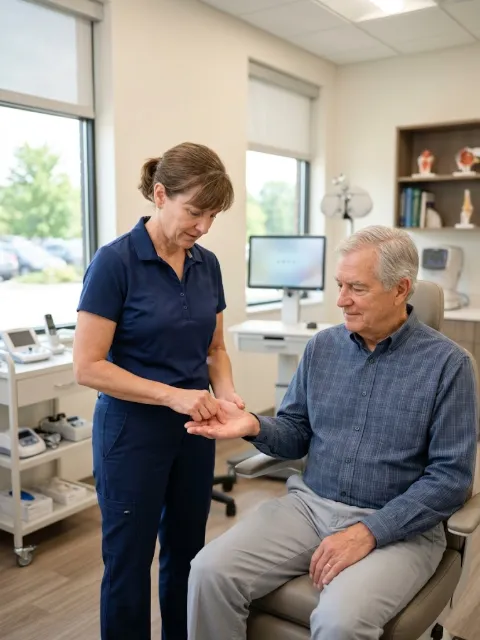
Simple, painless tests: light taps or strokes on the face and hands, along with balance and eye movement testing. There are no needles and no imaging.
Is this covered by insurance?
Coverage varies by plan. Our team will help verify your benefits and explore payment options.
Related Care at Brain Vision Institute
More for adults 55+
- All 55+ services
- Neurodegenerative Conditions
- Brain-Visual Longevity Evaluation
- Glaucoma & Cognitive Decline
Primitive reflex care for other ages
Learn about our approach
References
- Neuro-Optometric Rehabilitation Association. (n.d.). Primitive Reflexes. (Provides information on the significance of retained reflexes).
- Damasceno, A., et al. (2005). Primitive reflexes and cognitive function. Arquivos de Neuro-Psiquiatria, 63(3A), 577–582.
- College of Optometrists in Vision Development. (n.d.). Primitive Reflexes. (Explains the role of vision in reflex integration).
- Amen, D. G. (2021). The End of Mental Illness. Tyndale House Publishers. (Provides context on frontal lobe function and brain health).
- Peer-reviewed journals on the correlation between frontal release signs and the progression of neurodegenerative diseases.
- American Academy of Neurology. (Provides clinical guidelines on the diagnosis of dementia).
- National Institute on Aging. (Provides information on the early signs of Alzheimer’s disease).
- Andrich, A., & Andrich, P. (2019). Focusing on the Re-Emergence of Primitive Reflexes Following Acquired Brain Injuries. Neuro-Optometric Rehabilitation Association (NORA).
Know Your Baseline. Protect Your Future.
Changes in balance, reaction time or memory deserve answers. A primitive reflex assessment is a simple, non-invasive way to understand what your nervous system is telling you, and to act early.