Vision & Nutrition for Adults
Your Eyes Are Sending a Warning. Are You Listening?
Dryness, irritation, and changes in your vision aren’t just signs of getting older. They are often the first signs of inflammation and degeneration that can be managed and even prevented with targeted nutrition. At Brain Vision Institute, we use a science-backed, food-first approach to protect your vision from the inside out, helping you manage chronic conditions and preserve your sight for years to come.

A
reduction in risk of progression to late-stage macular degeneration — that’s what the landmark AREDS2 study found from targeted nutrient supplementation.
It’s Not Just ‘Getting Older.’ It’s Inflammation.

As an adult, you expect your body to change. But the constant grittiness of dry eyes, the frustration of allergies, or the fear of a diagnosis like macular degeneration doesn’t have to be your new normal. These conditions are often driven by chronic inflammation and oxidative stress — two processes that can be directly influenced by your diet.
Does this sound familiar?
- “My eyes feel constantly dry, gritty, and irritated, no matter how many drops I use.”
- “I’ve been diagnosed with early-stage macular degeneration and I feel helpless.”
- “Every spring, my eye allergies derail my life for weeks.”
- “I have diabetes, and I’m terrified of what it could do to my vision.”
- “My vision just doesn’t feel as sharp as it used to.”
These are not just symptoms to be managed; they are signals from your body that there is an underlying imbalance. By addressing the root cause with targeted nutrition, you can take back control of your eye health.
How Targeted Nutrients Protect and Restore Your Vision
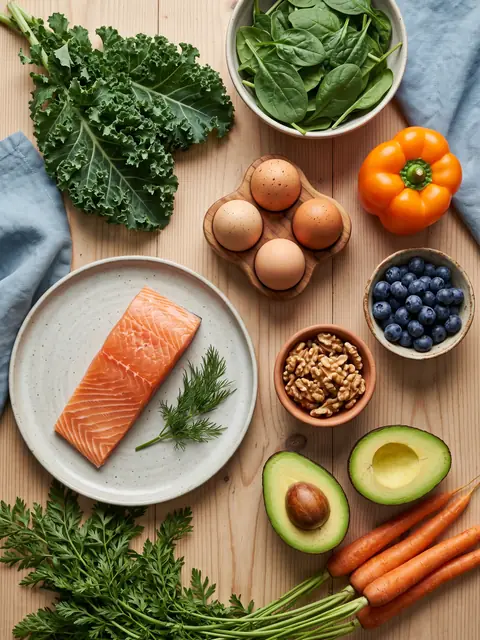
Your eyes have the highest metabolic rate of any organ in your body. They require a constant supply of specific nutrients to protect themselves from damage and function optimally. Modern diets, high in processed foods and inflammatory fats, can rob your eyes of the tools they need to stay healthy.
The Role of Key Nutrients:
For Macular Degeneration: The AREDS2 Formula
Lutein & Zeaxanthin act as “internal sunglasses,” filtering harmful blue light and protecting the macula. Vitamins C & E, Zinc, and Copper neutralize free radicals that damage retinal cells. The landmark AREDS2 study found this combination reduces the risk of progression to late-stage AMD by 25%.
For Dry Eye Disease: Omega-3 Fatty Acids
Chronic inflammation is a primary driver of dry eye. Omega-3 fatty acids (EPA and DHA) are potent anti-inflammatories that improve meibomian gland function, reducing evaporative dry eye — confirmed by a meta-analysis of multiple clinical studies.
For Eye Allergies: Natural Antihistamines
Quercetin is a plant-based compound that stabilizes mast cells, preventing them from releasing the histamine that causes itching, redness, and watering. Vitamin C works synergistically with quercetin to reduce the allergic response.
For Diabetic Retinopathy: Blood Sugar & Anti-Inflammatories
A low-glycemic diet rich in fiber and healthy fats helps control the blood sugar spikes that damage delicate retinal blood vessels. Omega-3s and Vitamin D help reduce retinal inflammation and vascular leakage associated with diabetic eye disease.
A Personalized, Food-First Approach to Eye Health
We believe in using targeted nutrition as a primary tool to support your vision. Our process is designed to give you a clear, actionable plan based on your unique biology and lifestyle.
The Comprehensive Vision & Nutrition Assessment
1
We start with a deep dive into your health history, symptoms, and current diet — and may recommend advanced testing to identify specific nutritional deficiencies or inflammatory markers, combined with a comprehensive eye health evaluation.
Your Personalized Nutrition Roadmap
2
Based on your assessment, we create a personalized nutrition plan tailored to your specific condition — not a restrictive diet, but a strategic plan to incorporate powerful, eye-healthy foods and, when necessary, targeted, high-quality supplements.
Ongoing Support & Monitoring
3
We don’t just hand you a plan and send you on your way. We provide ongoing support, coaching, and regular monitoring to track your progress, adjust your plan as needed, and ensure you are achieving your health goals.
How Changing Their Diet Changed Their Vision


Your Questions, Answered
Can I just take a multivitamin?
Standard multivitamins do not contain the therapeutic doses of specific nutrients needed to manage eye diseases. For example, the amount of lutein, zeaxanthin, and antioxidants in the AREDS2 formula is many times higher than what is found in a typical multivitamin.
How long does it take to see results from nutritional changes?
While some people notice improvements in a few weeks, it typically takes 2-3 months of consistent nutritional changes and supplementation to see significant, lasting results. The goal is to create long-term cellular change, which takes time.
Do I have to give up all the foods I love?
Not at all. Our approach is about strategic additions, not just subtractions. We focus on incorporating more nutrient-dense, anti-inflammatory foods into your diet while helping you find healthier swaps for the foods that may be contributing to inflammation.
Are the supplements you recommend safe?
Yes. We only recommend professional-grade, third-party tested supplements to ensure purity, potency, and safety. We will always review your current medications and health history to ensure there are no contraindications.
Related Care at Brain Vision Institute
More for adults
- All adult services
- Dry Eye Treatment
- Brain Fog, Headaches & Visual Fatigue
- Photobiomodulation & Syntonics
Vision & nutrition for other ages
Learn about our approach
References
- National Eye Institute. (2021). AREDS 2 Supplements for Age-Related Macular Degeneration. Retrieved from nei.nih.gov
- Khoo, H. E., et al. (2019). Nutrients for Prevention of Macular Degeneration and Eye-Related Diseases. Antioxidants, 8(4), 85.
- Wang, L., et al. (2024). Effect of supplementation with lutein, zeaxanthin, and omega-3 fatty acids on macular pigment and visual function in young adults with long-term use of digital devices. Frontiers in Nutrition, 11.
- Dawczynski, J., et al. (2013). Long term effects of lutein, zeaxanthin and omega-3-LCPUFAs supplementation on optical density of macular pigment in AMD patients: the LUTEGA study. Graefe’s Archive for Clinical and Experimental Ophthalmology, 251(12), 2711-2723.
- Macular Degeneration Foundation. (n.d.). Nutrition for Age-Related Macular Degeneration. Retrieved from mdfoundation.com.au
- Liu, A., et al. (2014). Omega-3 Essential Fatty Acids Therapy for Dry Eye Syndrome: A Meta-Analysis of Randomized Controlled Studies. Medical Science Monitor, 20, 1583-1589.
- Kangari, H., et al. (2013). Short-term Consumption of Oral Omega-3 and Dry Eye Syndrome. Ophthalmology, 120(11), 2191-2196.
- Cong, Y., et al. (2024). Recommendations for nutritional supplements for dry eye disease: current advances. Frontiers in Pharmacology, 15.
- Bhandarkar, N. S., et al. (2024). Nutrition and diet for dry eye disease: Insights toward clinical practice. Frontiers in Nutrition.
- Johns Hopkins Medicine. (n.d.). Nutrition and Eye Health. Retrieved from hopkinsmedicine.org
- Zhang, P., et al. (2023). The Role of Diet and Nutrition in Allergic Diseases. Nutrients, 15(17), 3683.
- McKay, T. B., et al. (2017). Quercetin and the ocular surface: What we know and where we are going. Experimental Eye Research, 164, 109-118.
- Mlcek, J., et al. (2016). Quercetin and its anti-allergic immune response. Molecules, 21(5), 623.
- Najafi, N. N., et al. (2024). Quercetin a promising functional food additive against allergic diseases. Food Chemistry, 458, 140543.
- Naso, M., et al. (2025). Quercetin and Its Lecithin-Based Formulation: Potential Applications for Allergic Diseases Based on a Narrative Review. Nutrients, 17(9), 1476.
- Valero-Vello, M., et al. (2021). Searching for the Antioxidant, Anti-Inflammatory, and Neuroprotective Potential of Natural Food and Nutritional Supplements for Ocular Health in the Mediterranean Population. Foods, 10(6), 1231.
- D’Angelo, A., et al. (2025). The Role of Diet and Oral Supplementation for the Management of Diabetic Retinopathy and Diabetic Macular Edema: A Narrative Review. BioMed Research International.
- Rondanelli, M., et al. (2023). Diet and ideal food pyramid to prevent or support the treatment of diabetic retinopathy, age-related macular degeneration, and cataracts. Frontiers in Medicine, 10.
- Lee, D., et al. (2024). Therapeutic effects of anti-inflammatory and anti-oxidant nutritional supplementation in retinal ischemic diseases. International Journal of Molecular Sciences, 25(10), 5503.
- Christen, W. G., et al. (2020). Effect of Vitamin D and ω-3 Fatty Acid Supplementation on Risk of Age-Related Macular Degeneration. JAMA Ophthalmology, 138(12), 1280-1289.
- Vergroesen, J. E., et al. (2023). The inflammatory potential of diet is associated with the risk of age-related eye diseases. Clinical Nutrition, 42(12), 2437-2444.
- American Academy of Ophthalmology. (2024). 36 Fabulous Foods to Boost Eye Health. Retrieved from aao.org
- American Optometric Association. (2023). 2023 Eye-Q Survey. Retrieved from aoa.org
- Wang, X., et al. (2025). Association of dietary inflammatory index with ocular diseases: a population-based cross-sectional study. European Journal of Medical Research, 30(1), 1-10.
Your Vision is Too Important to Leave to Chance
Don’t wait for symptoms to worsen. A proactive, nutritional approach is one of the most powerful tools you have to protect your sight. Schedule a consultation today to learn how a personalized nutrition plan can help you manage your condition and preserve your vision for a lifetime.